
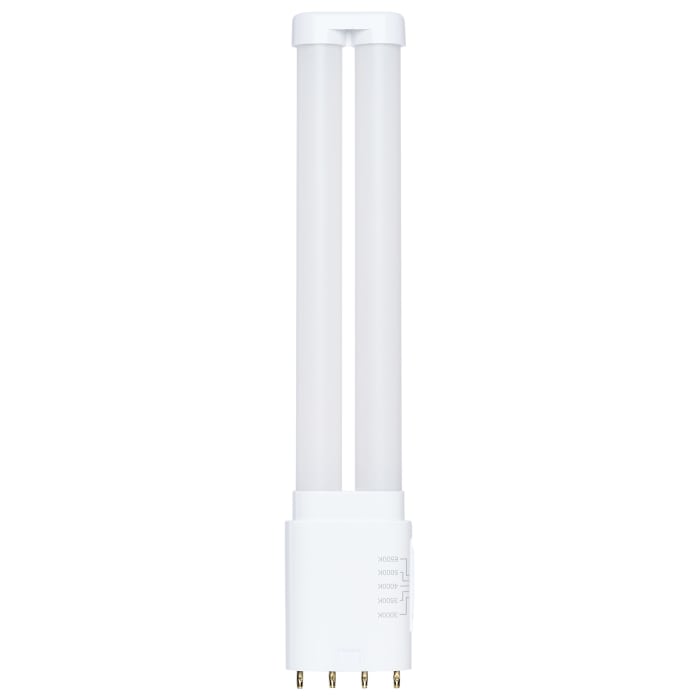
If you’ve ever removed a long plug-in fluorescent bulb from an office ceiling fixture, medical building, school, or commercial space, there’s a good chance you’ve handled a PLL lamp.
Although they aren’t as well known as A19 or PAR30 bulbs, PLL lamps have been an important part of commercial lighting for decades. Today, many businesses, property managers, churches, schools, and homeowners with specialty fixtures are replacing these fluorescent lamps with modern LED technology.
At Unique Lighting & Home Decor, we frequently help customers identify plug-in fluorescent lamps and determine the best LED replacement. If you’ve seen part numbers like 10PLL/LED/5CCT/AB, this guide explains exactly what they mean and how to choose the right replacement.
What Is a PLL Light Bulb?
A PLL (also written PL-L) lamp is a long, linear compact fluorescent lamp (CFL) designed to plug into a dedicated socket rather than screw into a standard light fixture.
Unlike traditional fluorescent tubes, PLL lamps fold the glass tubing into a compact shape while still producing a large amount of light.
They’ve been widely used in:
- Commercial offices
- Schools
- Hospitals
- Medical clinics
- Churches
- Retail stores
- Hotels
- Apartment common areas
- Municipal buildings
Because of their compact size and high light output, PLL lamps became a popular alternative to larger fluorescent tubes.
How Do PLL Lamps Work?
Traditional PLL lamps use the same basic technology as other fluorescent lights.
Inside the glass tube is a small amount of mercury vapor and inert gas. When electricity passes through the lamp, it creates ultraviolet (UV) light. A phosphor coating on the inside of the glass converts that UV light into visible light.
Like other fluorescent lamps, traditional PLL bulbs require a ballast to regulate current and start the lamp.
What Does “10PLL/LED/5CCT/AB” Mean?
One reason LED replacement lamps can seem confusing is their model numbers. Breaking the number apart helps explain what you’re buying.
Using 10PLL/LED/5CCT/AB as an example:
- 10PLL – Indicates the lamp style and approximate wattage class.
- LED – Uses light-emitting diode technology instead of fluorescent technology.
- 5CCT – Offers five selectable color temperatures, allowing the installer to choose the desired light color before installation.
- AB – Typically indicates the lamp is designed to operate with either an existing ballast or a ballast bypass configuration, depending on the manufacturer’s specifications. Always verify the installation instructions for the specific product before installation.
One of the biggest advantages of many modern LED replacements is the flexibility they provide when updating existing fixtures.
Why Replace a Fluorescent PLL Lamp with LED?
LED technology offers several advantages over traditional fluorescent lighting.
Lower Energy Consumption
LED replacements generally consume significantly less electricity while producing comparable light output.
Longer Lifespan
Quality LED PLL replacements often last two to three times longer than fluorescent lamps, reducing maintenance costs in hard-to-reach fixtures.
No Mercury
Unlike fluorescent lamps, LED replacements do not contain mercury, making disposal simpler and reducing environmental concerns.
Instant Full Brightness
LED lamps reach full brightness immediately without the warm-up time sometimes experienced with fluorescent lighting.
Better Cold Weather Performance
LEDs perform well in unheated garages, storage buildings, and outdoor enclosed fixtures where fluorescent lamps may struggle.
Ballast Compatible vs. Ballast Bypass
One of the most important considerations when replacing a PLL lamp is understanding how the new LED lamp is designed to operate.
Ballast Compatible
Some LED replacements are designed to work with an existing compatible electronic ballast.
Advantages include easier installation with minimal fixture modification.
However, the ballast remains another component that may eventually fail.
Ballast Bypass
Other LED lamps require the ballast to be removed or bypassed.
Advantages include:
- Eliminating ballast failures
- Reducing future maintenance
- Improving long-term efficiency
Because ballast bypass installation changes the fixture wiring, it should always follow the manufacturer’s instructions and applicable electrical codes.
Hybrid Lamps
Products like the 10PLL/LED/5CCT/AB may support both installation methods, providing flexibility depending on the condition of the existing fixture.
Always verify the installation method specified by the manufacturer before installing any replacement lamp.
Choosing the Right Color Temperature
Many LED PLL replacements now include selectable color temperatures.
Typical choices include:
| Color Temperature | Best Applications |
|---|---|
| 2700K | Hospitality, residential common areas |
| 3000K | Restaurants, churches, waiting rooms |
| 3500K | Offices, classrooms |
| 4000K | Retail, healthcare, workshops |
| 5000K | Warehouses, utility areas, task lighting |
Selectable color temperature makes it easier to match existing lighting or update the appearance of a space without replacing multiple lamp styles.
Common Applications for PLL LED Lamps
You’ll often find these lamps in:
- Office troffers
- Commercial ceiling fixtures
- Medical offices
- Schools
- Churches
- Hallways
- Retail stores
- Apartment corridors
- Hospitality properties
- Government buildings
As fluorescent technology continues to phase out, LED replacements help extend the life of existing fixtures while improving energy efficiency.
Common Mistakes to Avoid
Buying the Wrong Base
PLL lamps are available with different pin configurations. Always verify that the replacement matches the socket in your fixture.
Ignoring Ballast Requirements
Not every LED replacement installs the same way. Verify whether your lamp is ballast compatible, ballast bypass, or hybrid.
Choosing the Wrong Length
PLL lamps come in several lengths and wattages. Match both the physical dimensions and the electrical specifications.
Mixing Color Temperatures
Replacing only one lamp with a different color temperature can result in uneven lighting throughout the fixture.
Showroom Tip
One of the easiest ways to identify the correct PLL replacement is to bring the old lamp—or simply take a clear photo of the label on the lamp and the fixture. That information usually tells us everything we need to recommend a compatible LED replacement.
Visit Unique Lighting & Home Decor
Whether you’re replacing a single commercial lamp or upgrading an entire office building to LED, we’re here to help.
At Unique Lighting & Home Decor, we can help identify PLL lamps, explain ballast compatibility, and recommend LED replacements that fit your fixture and your lighting goals.
Visit us at:
Unique Lighting & Home Decor
926 S. Arizona St.
Butte, MT 59701
If you’ve never wandered through our showroom, you should. While many people think of us for decorative lighting, we also stock and source specialty replacement lamps for residential, commercial, and industrial applications.
References (APA 7th Edition)
National Electrical Manufacturers Association. (2020). ANSI C78 Series: Electric Lamps—Dimensional and Electrical Characteristics.
U.S. Department of Energy. (n.d.). LED Lighting. https://www.energy.gov/energysaver/led-lighting
U.S. Environmental Protection Agency. (n.d.). Frequent Questions About Fluorescent Lamps and Mercury. https://www.epa.gov/cfl


Leave a Reply