
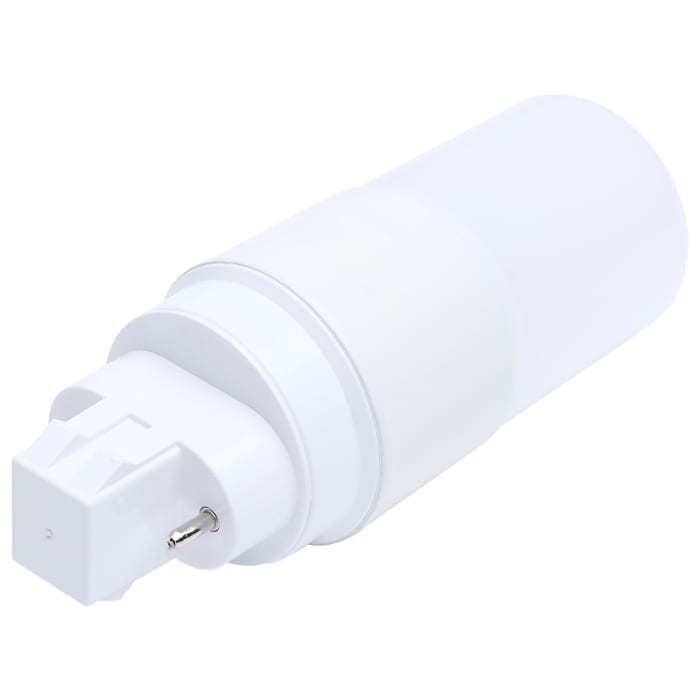
Most homeowners are familiar with standard screw-in light bulbs like A19s or decorative chandelier bulbs, but many commercial buildings, apartments, hotels, and even some homes use a completely different style of lamp.
If you’ve removed a bulb that plugs into a socket instead of screwing in, and it has two pins on the bottom, you may have a GX23 compact fluorescent lamp, often referred to as a PL-S lamp. These lamps have been widely used for decades because they provide good light output in a compact package, and today many are being replaced with modern LED versions.
At Unique Lighting & Home Decor, we regularly help customers identify these specialty lamps and choose the correct replacement. If your existing bulb has a model number similar to 5CFL/L/840/GX23/AB/FR/U, this guide will help you understand what it means and what your replacement options are.
What Is a GX23 Light Bulb?
A GX23 lamp is a plug-in compact fluorescent lamp (CFL) or LED replacement that uses a two-pin GX23 base instead of a traditional screw base.
Unlike an A19 bulb that screws into a socket, a GX23 lamp plugs directly into a matching socket using two pins spaced according to the GX23 standard. The “GX23” designation refers to the base configuration, not the shape of the lamp itself.
Traditional GX23 lamps were fluorescent, while many modern replacements now use LED technology.
Understanding a Model Number
A model such as:
5CFL/L/840/GX23/AB/FR/U
can look intimidating, but each section provides useful information.
Although manufacturers use slightly different naming conventions, the components typically indicate:
- 5CFL – Compact fluorescent replacement wattage class or LED equivalent
- L – Lamp designation
- 840 – 80+ CRI with a 4000 Kelvin (Cool White) color temperature
- GX23 – Two-pin GX23 base
- AB – Ballast-compatible or hybrid operation (depending on manufacturer)
- FR – Frosted lens or diffuser
- U – U-shaped lamp design
Always verify the exact manufacturer’s specifications, as suffixes can vary between brands.
Where Are GX23 Lamps Used?
GX23 lamps are common in fixtures where a compact light source is needed.
You’ll often find them in:
- Office buildings
- Medical clinics
- Schools
- Apartment common areas
- Hotels
- Hallways
- Utility rooms
- Commercial restrooms
- Wall sconces
- Ceiling fixtures
Because the ballast is typically installed inside the fixture rather than the lamp, these systems were designed for easy lamp replacement.
How Traditional GX23 CFL Lamps Work
Traditional GX23 lamps are non-integrated compact fluorescent lamps.
Instead of producing light with a filament, they operate by sending electricity through mercury vapor inside the lamp. This produces ultraviolet light, which strikes a phosphor coating on the inside of the tube, creating visible light.
To operate correctly, fluorescent GX23 lamps require a ballast that starts the lamp and regulates electrical current.
Why Homeowners and Businesses Are Switching to LED
LED technology has changed how these fixtures are maintained.
Modern GX23 LED replacement lamps provide several advantages.
Lower Energy Consumption
LED replacements typically use significantly less electricity than comparable fluorescent lamps while producing similar usable light.
Longer Lifespan
Quality LED replacements often last much longer than traditional compact fluorescent lamps, reducing maintenance in hard-to-reach fixtures.
No Mercury
Unlike fluorescent lamps, LED replacements do not contain mercury.
Instant Brightness
LED lamps turn on immediately without warm-up time.
Better Cold-Weather Performance
LED technology performs much better in cold environments where fluorescent lamps may start slowly or produce reduced light output.
Ballast Compatible vs. Ballast Bypass
One of the most important things to understand before purchasing a GX23 LED replacement is how it’s designed to operate.
Ballast Compatible
Some LED lamps work with an existing compatible ballast.
Advantages include:
- Faster installation
- No rewiring
- Less fixture modification
However, the ballast remains another component that may eventually fail.
Ballast Bypass
Other LED replacements require removing or bypassing the ballast.
Advantages include:
- Eliminates future ballast failures
- Lower long-term maintenance
- Improved system efficiency
Because ballast bypass changes the fixture wiring, installation should always follow the manufacturer’s instructions and applicable electrical codes.
Hybrid Lamps
Many newer GX23 LED lamps are hybrid products.
These lamps can often operate with a compatible ballast initially and later be converted to ballast bypass if the ballast eventually fails.
This flexibility makes future maintenance much easier.
Understanding Color Temperature
Many GX23 LED lamps are available in multiple color temperatures.
2700K
Warm White
Ideal for hospitality, residential common areas, and decorative applications.
3000K
Soft White
Excellent for waiting rooms, churches, and restaurants.
3500K
Neutral White
Frequently selected for offices and educational facilities.
4000K
Cool White
One of the most common commercial lighting choices for offices, healthcare facilities, and retail stores.
5000K
Daylight
Popular for warehouses, maintenance shops, utility rooms, and task-oriented workspaces.
What Does “840” Mean?
One of the most confusing markings on fluorescent and LED commercial lamps is the three-digit color code.
For example:
840
The first digit indicates the approximate Color Rendering Index (CRI).
- 8 = CRI of approximately 80 or higher.
The last two digits indicate the color temperature.
- 40 = 4000 Kelvin
Other common examples include:
| Code | Color Temperature |
|---|---|
| 827 | 2700K Warm White |
| 830 | 3000K Soft White |
| 835 | 3500K Neutral White |
| 840 | 4000K Cool White |
| 850 | 5000K Daylight |
Understanding these codes makes replacing commercial lamps much easier.
Common Mistakes to Avoid
Buying by Appearance Alone
Many plug-in fluorescent lamps look similar but use completely different bases.
Always verify the base type before purchasing.
Ignoring Ballast Compatibility
Not every LED replacement works the same way.
Confirm whether your replacement is:
- Ballast compatible
- Ballast bypass
- Hybrid
Choosing the Wrong Color Temperature
Replacing only one lamp with a different color temperature can create noticeably uneven lighting.
Forgetting to Verify Pin Configuration
GX23 is only one of several compact fluorescent base types.
Similar-looking lamps may use G23, G24, GX24, or other pin configurations that are not interchangeable.
Showroom Tip
One of the most common questions we hear is:
“This plug-in bulb looks exactly like mine. Why doesn’t it fit?”
In most cases, the issue isn’t the lamp length—it’s the base. Bringing your old lamp or a clear photo of the label allows us to identify the correct replacement quickly and accurately.
Visit Unique Lighting & Home Decor
Whether you’re replacing one plug-in lamp or upgrading an entire commercial building to LED, we’re here to help.
At Unique Lighting & Home Decor, we help homeowners, contractors, electricians, facility managers, and business owners identify specialty lamps and choose LED replacements that fit their fixtures and lighting goals.
Visit us at:
Unique Lighting & Home Decor
926 S. Arizona St.
Butte, MT 59701
If you’ve never wandered through our showroom, you should.
Bring your old lamp—or simply take a picture of the bulb and fixture label—and we’ll help you identify the correct replacement the first time.
References (APA 7th Edition)
National Electrical Manufacturers Association. (2020). ANSI C81 Series: Lamp Bases and Holders.
U.S. Department of Energy. (n.d.). LED Lighting. https://www.energy.gov/energysaver/led-lighting
U.S. Environmental Protection Agency. (n.d.). Frequent Questions About Fluorescent Lamps and Mercury. https://www.epa.gov/cfl
Philips Lighting. (n.d.). PL-S Compact Fluorescent Lamps.
Green Creative. (n.d.). GX23 Hybrid LED Replacement Lamps.


Leave a Reply