
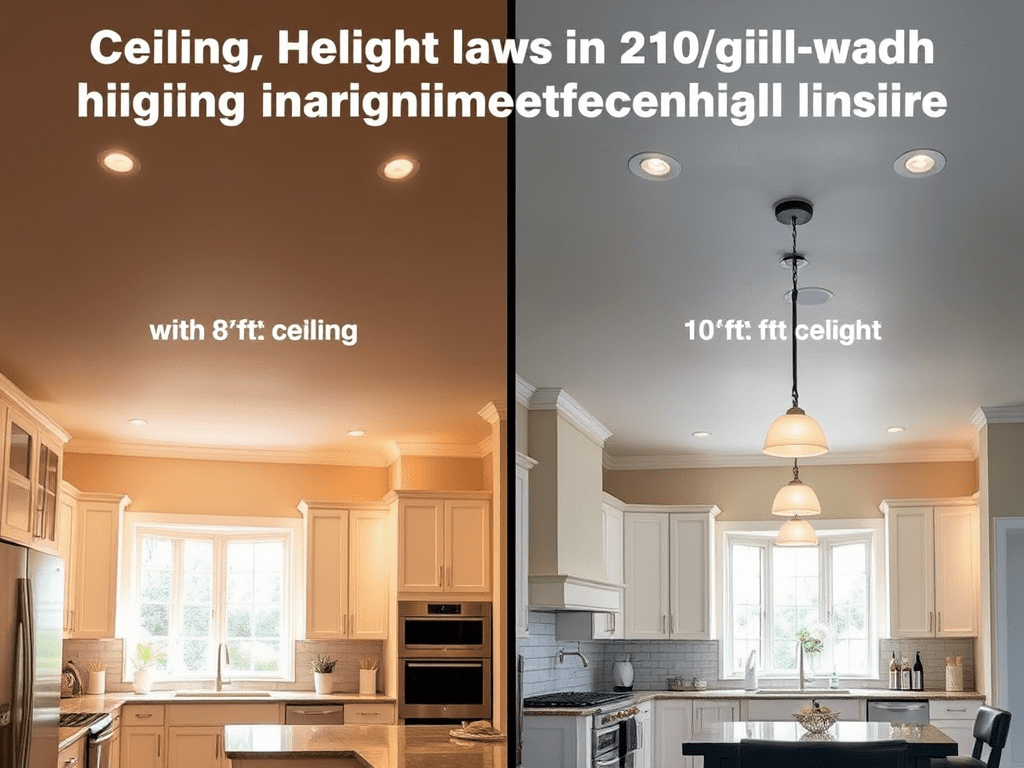
When homeowners think about lighting decisions, they usually focus on fixture style, brightness, or placement on the floor plan. What often gets overlooked is one of the most powerful variables in how light actually behaves inside a home: ceiling height.
A fixture does not perform the same way simply because it is installed in the same room type. The height between fixture and surface changes how light spreads, where shadows fall, how glare is perceived, and whether a room feels comfortable after dark.
This is why two kitchens of similar size can feel completely different at night even if they use similar fixtures. Ceiling height changes everything.
Light Weakens as Distance Increases
The farther light travels, the more its intensity spreads before reaching a surface.
That means a recessed fixture mounted in an 8-foot ceiling delivers a concentrated pool of light with stronger task performance than the same fixture mounted in a 10-foot ceiling.
At greater heights:
- beam spread widens
- intensity softens
- edge definition weakens
- task precision declines
This often creates a misleading reaction during planning: homeowners think the answer is simply “add more lights.”
In many cases, the real solution is different fixture specification, beam angle selection, or altered spacing.
Without understanding ceiling height, adding more fixtures can actually create visual clutter without improving performance.
Why Tall Ceilings Often Feel Darker at Night
Many homes with taller ceilings look beautiful during the day because natural light fills vertical volume.
At night, that same volume becomes difficult to balance if lighting only addresses the floor plane.
This creates a common effect:
- countertops feel bright
- ceilings disappear
- upper walls fall dark
- the room feels visually hollow
People often describe this sensation as a room feeling “cold” or “unfinished” after sunset, even when brightness levels appear adequate.
The reason is simple: lighting is reaching surfaces but not shaping volume.
Tall spaces require intentional vertical illumination so the room feels visually connected from floor to ceiling.
Fixture Scale Must Match Architectural Volume
A fixture that looks proportional in a standard room may visually disappear in a larger volume.
For example:
A flush mount selected for a 9-foot ceiling may feel undersized in a room with 11-foot ceilings because the fixture no longer carries visual weight relative to the room volume.
This affects not only appearance, but how light is psychologically perceived.
Larger vertical spaces often require:
- broader fixtures
- stronger visual anchors
- multiple layers rather than single-source lighting
The goal is not just filling the room with light — it is creating balance between architectural scale and lighting presence.
Ceiling Height Changes Glare Behavior
Higher ceilings often lead homeowners to believe glare will automatically reduce because fixtures are farther away.
That is not always true.
In tall rooms, glare often becomes noticeable from seated positions when beam angles intersect line of sight.
This is especially true in:
- vaulted great rooms
- kitchen ceilings viewed from seating areas
- stairwells
- open loft transitions
Fixture trim selection matters greatly here.
A poorly chosen trim in a tall ceiling can create direct visual discomfort that is felt every evening.
Vaulted Ceilings Require Completely Different Thinking
Sloped ceilings change light direction.
A recessed light installed in a vaulted ceiling does not simply point downward unless specifically designed to compensate for angle.
Without angle correction:
- beams skew unevenly
- glare appears from across the room
- brightness clusters awkwardly
This is why vaulted ceilings often require adjustable trims, beam recalculation, or alternate fixture categories altogether.
Standard layouts fail here more often than homeowners realize.
Why Ceiling Height Must Be Discussed Before Rough-In
By the time wiring begins, fixture category assumptions are often already embedded.
If ceiling height has not influenced fixture planning by rough-in stage:
- spacing may already be wrong
- switch grouping may assume incorrect brightness levels
- dimming needs may be underestimated
Ceiling height is not simply an architectural detail.
It is one of the primary performance variables in lighting design.
A room is not lit correctly because fixtures are installed.
It is lit correctly when fixture behavior matches volume.


Leave a Reply