
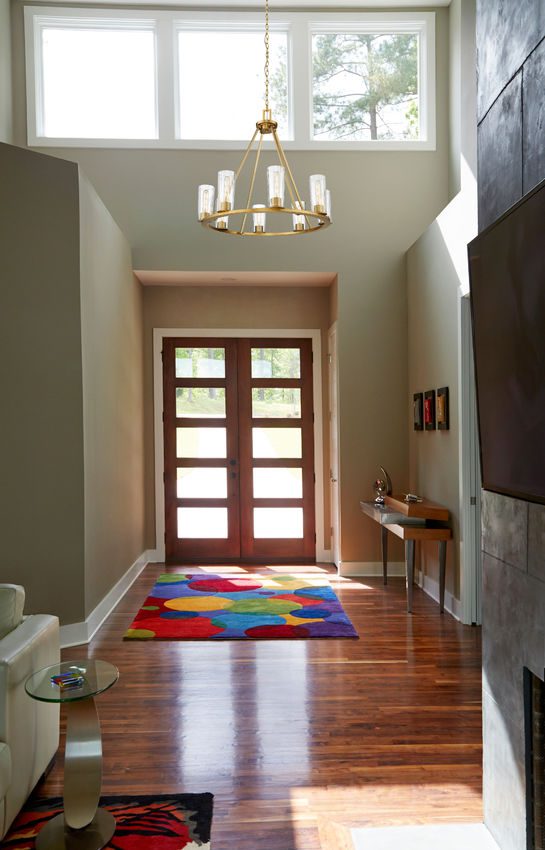
One of the most common misunderstandings in residential lighting is the assumption that if a room feels bright, it must be well lit.
Brightness is only one part of lighting performance. A room can have plenty of lumens and still feel uncomfortable, visually tiring, or poorly designed.
This happens because human comfort depends less on total light quantity and more on how light is distributed, where contrast occurs, and how surfaces interact with that light over time.
Many homes that initially impress people with brightness become the same homes where homeowners later say:
- “This room feels harsh at night.”
- “It’s bright, but it doesn’t feel comfortable.”
- “We never use all these lights.”
That usually means the room was lit for output, not for experience.
Brightness Without Balance Creates Visual Fatigue
The human eye constantly adjusts to brightness relationships, not just brightness levels.
If one area of a room is significantly brighter than another, your eyes repeatedly compensate.
A common example:
- very bright ceiling downlights
- dark wall surfaces
- darker corners
- no vertical illumination
The ceiling appears active, but the room feels uneven.
This is because the brightest points dominate vision while darker surfaces disappear.
The result is subtle fatigue, especially at night when pupils naturally widen.
This is why some bright rooms feel strangely exhausting after an hour.
The Difference Between Quantity and Distribution
Imagine two identical rooms.
Room A has six bright recessed lights evenly spaced.
Room B has four recessed lights, wall illumination, a lamp layer, and controlled dimming.
Room A may measure brighter on paper.
Room B almost always feels better to live in.
Why?
Because distributed light creates visual stability.
Good distribution means:
- no abrupt dark pockets
- no concentrated glare points
- light reaches both horizontal and vertical surfaces
- brightness feels intentional rather than scattered
The goal is not simply making light visible.
The goal is making surfaces readable and comfortable.
Why Walls Matter More Than People Expect
Walls are one of the most important surfaces in lighting comfort.
If walls remain dark while floors and counters are bright, the room loses depth.
This often happens in kitchens and great rooms where ceiling lighting dominates but walls receive little attention.
Dark walls create:
- reduced spatial depth
- stronger contrast fatigue
- visual flattening
Lighting walls softly helps a room feel larger, calmer, and more balanced.
That is why a room with fewer fixtures can still feel better than a room with more.
Brightness Can Hide Poor Task Performance
A room may appear bright overall while still failing functionally.
A kitchen is the best example.
The ceiling may feel bright, yet:
- prep counters remain shadowed
- sinks feel dim
- cutting surfaces are inconsistent
This happens because total room brightness is mistaken for task effectiveness.
Task lighting depends on direction, not just output.
A bright room can still create shadows exactly where work happens.
Why Dimming Changes Everything
Many homeowners think dimming simply lowers brightness.
In reality, dimming changes how contrast is perceived.
A bright room at full output may feel sharp and clinical at night.
That same room dimmed slightly often becomes dramatically more comfortable because contrast softens.
Dimming allows one lighting system to serve:
- daytime tasks
- evening relaxation
- entertaining
- transition periods
Without dimming, one brightness level must serve every condition.
That rarely works well.
A Well-Lit Room Feels Effortless
People rarely walk into a well-lit room and think about why it feels good.
They simply feel at ease.
That usually means:
- brightness is balanced
- surfaces are legible
- glare is controlled
- transitions are soft
The best lighting is rarely noticed because nothing in the room fights your eyes.
Brightness matters.
But distribution determines whether brightness becomes comfort or fatigue.


Leave a Reply