
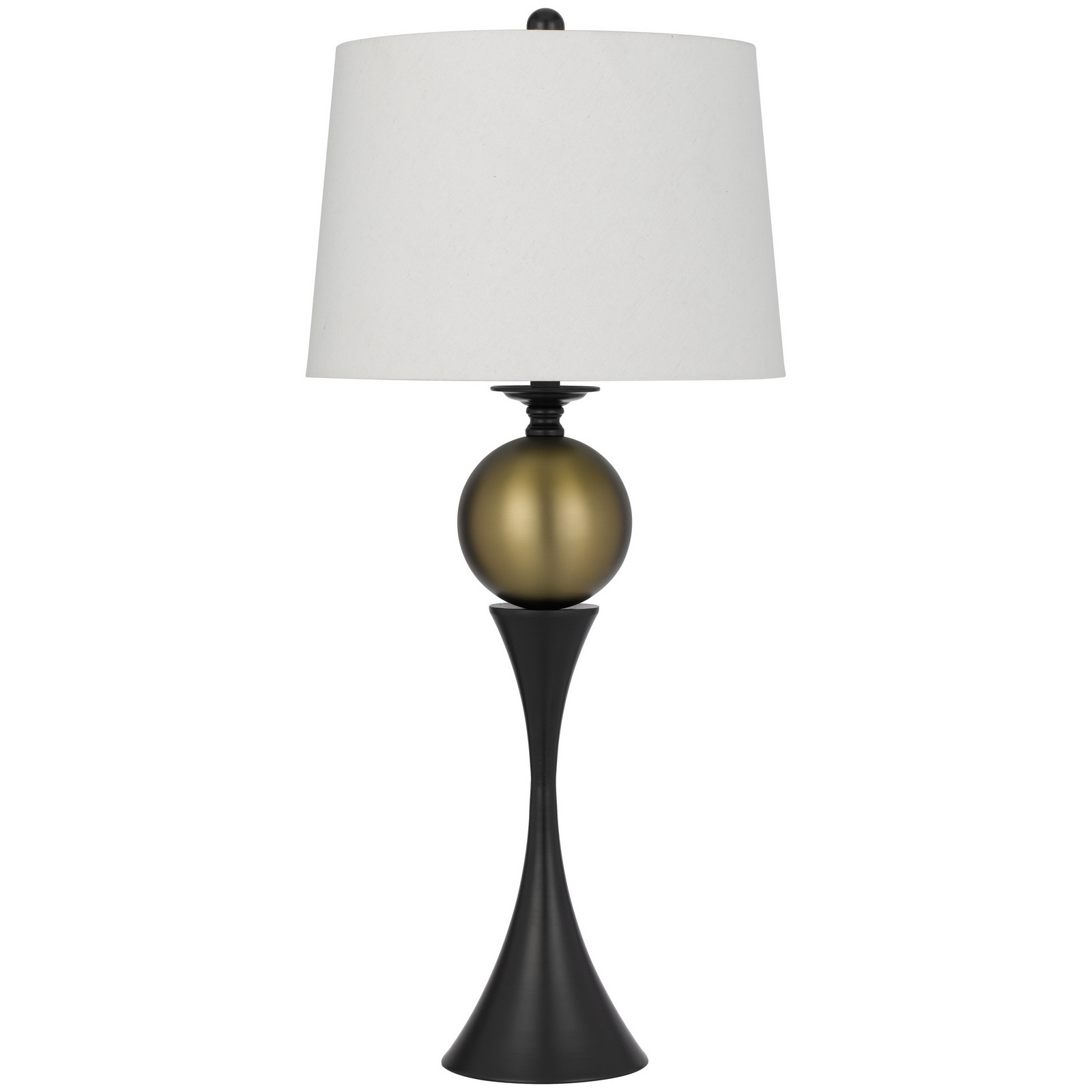
Ceiling fixtures get a lot of attention when we talk about lighting a home.
But sometimes the light a room is missing isn’t on the ceiling.
It’s sitting beside the sofa.
On the nightstand.
Next to your favorite chair.
On your desk.
On a console table in the entry.
Or in that dark corner of the living room that never seems to get enough light.
Lamps are one of the easiest ways to add another layer of light to an existing room without necessarily changing the electrical layout. They can provide useful task lighting, contribute to the room’s overall illumination and become decorative elements themselves.
But a table lamp, desk lamp and floor lamp don’t necessarily serve the same purpose.
Choosing the right lamp starts with a simple question:
What do you need the lamp to do?
Once you know that, decisions about lamp type, placement, size, shade and light output become much easier.
First: A Lamp Is More Than Decoration
The Illuminating Engineering Society (IES) defines a table lamp as a portable luminaire with a short stand designed to sit on furniture (Illuminating Engineering Society [IES], n.d.-a).
That word portable is one of the things that makes lamps so useful.
Unlike a hardwired chandelier, pendant or wall sconce, a typical plug-in lamp can be relocated as the room and its lighting needs change. UL Solutions similarly describes portable luminaires as generally freestanding products with cord-and-plug connections that allow them to be relocated as illumination needs change (UL Solutions, n.d.-a).
That makes lamps particularly useful when:
- A room doesn’t have enough built-in lighting.
- You need light closer to a particular activity.
- You want another lighting layer without modifying the electrical system.
- Furniture arrangements change periodically.
- A reading chair needs its own light.
- A desk needs dedicated task lighting.
- A bedside table needs convenient illumination.
- A dark corner needs additional light.
- You want to introduce another decorative element into the room.
Lamps can therefore be both functional lighting and part of the room’s design.
UL Solutions identifies table and floor lamps among the many types of indoor decorative lighting and notes that task, accent and ambient lighting serve different purposes throughout the home (UL Solutions, n.d.-b).
The key is selecting a lamp based on the job you expect it to perform.
Table Lamps: Flexible Light Where You Need It
When someone says “lamp,” a table lamp may be the first thing that comes to mind.
Table lamps can work in many areas of a home, including:
- Living rooms
- Bedrooms
- Family rooms
- Home offices
- Entries
- Dining rooms
- Libraries
- Guest rooms
- Console tables
Their function can change substantially depending on where they’re placed.
A table lamp beside a sofa may contribute to general room illumination.
A lamp beside a chair may provide useful reading light.
A pair of table lamps can help visually anchor furniture.
A lamp on an entry console may be more decorative and atmospheric.
A bedside lamp may need to serve several purposes at once.
So don’t start by asking:
“What table lamp looks good?”
Start with:
“What do I need this table lamp to accomplish?”
Then consider appearance.
Bedside Lamps: Think About the Person Using Them
A bedside lamp has a different job than a decorative lamp sitting on an entry console.
It may need to provide enough illumination for:
- Reading
- Getting ready for bed
- Finding something on the nightstand
- Moving around the room without turning on brighter overhead lighting
- Creating softer illumination in the evening
Placement matters because the useful height of the light source isn’t determined by the lamp alone.
It’s affected by the combined height of:
- The bed
- Mattress
- Nightstand
- Lamp
- Shade
That’s why universal advice such as “every bedside lamp should be exactly X inches tall” isn’t particularly useful.
Two people could own the exact same lamp and have very different results because one has a low platform bed with a short nightstand and the other has a tall mattress with taller furniture.
Don’t size a bedside lamp by itself. Size it in relationship to the furniture and the person using it.
This is one of the advantages of seeing lamps in person and discussing where they’re actually going.
Desk Lamps: Start With the Task
A desk lamp should first be evaluated as task lighting.
The IES defines task lighting as lighting directed toward a specific surface or area to provide illumination for visual tasks (IES, n.d.-b).
That distinction matters.
Your ceiling light may provide plenty of illumination throughout a home office while your actual work surface still isn’t illuminated the way you’d like.
A desk lamp can put light closer to the task.
When choosing one, consider:
- The size of the desk
- What you actually do at the desk
- Where the lamp will sit
- Whether its position can be adjusted
- Where the light is directed
- Whether your hands or equipment will create shadows
- Whether a computer monitor is involved
- Whether glare is noticeable
- How much desk space the lamp occupies
- Whether dimming or multiple output settings are useful
- Whether you prefer a replaceable bulb or integrated LED light source
An adjustable desk lamp can be especially useful because the light can be repositioned as the task changes.
The best desk lamp isn’t necessarily the brightest one. It’s the one that puts an appropriate amount of light where you need it without creating another problem somewhere else.
Floor Lamps: Lighting Without Another Piece of Furniture
Sometimes you need a lamp but don’t have—or don’t want—a table underneath it.
That’s where floor lamps become particularly useful.
Floor lamps can work well:
- Beside sofas
- Beside reading chairs
- In living-room corners
- In bedrooms
- In offices
- Behind or adjacent to furniture
- In areas where another table would make the room feel crowded
- Where portable additional illumination is useful
But “floor lamp” describes a broad category.
Different designs distribute light very differently.
Some direct illumination downward toward a reading or work area.
Some spread light through a shade.
Some direct significant light upward, allowing light to reflect from surrounding surfaces.
Others incorporate multiple light sources or adjustable arms.
That means two floor lamps that are roughly the same height may perform completely differently.
Look at where the light goes, not just what the lamp looks like when it’s turned off.
Reading Lamps: Put the Light Where the Reading Happens
A reading lamp is really a task-lighting application.
The goal isn’t simply to make the room brighter.
It’s to get useful illumination onto the book, magazine or other material being viewed.
That could come from:
- A table lamp
- An adjustable floor lamp
- A dedicated reading floor lamp
- An appropriately positioned desk lamp
Which one works best depends on the furniture arrangement and how the person uses the space.
Think about:
- Where you sit
- Where the lamp can physically go
- Where the shade or light source will be relative to you
- Whether the light reaches the reading material
- Whether the lamp can be adjusted
- Whether glare from the light source is distracting
- Whether the lamp will also contribute useful ambient light to the room
This is another reason buying a lamp solely because you like its shape can be disappointing.
It may be a beautiful lamp.
It just may not be a good reading lamp.
Living Room Lamps: One Lamp Doesn’t Have to Light the Whole Room
A living room often benefits from multiple lighting sources because it serves multiple purposes.
You may use the same room for:
- Conversation
- Reading
- Watching television
- Entertaining
- Relaxing
- Playing games
- Working
- Displaying art or collections
Trying to make one central ceiling fixture handle every one of those activities can be limiting.
Portable lamps give you another option.
For example, a living room might combine:
- A decorative central fixture
- Supplemental recessed or disk lighting
- Table lamps
- A floor lamp beside a reading chair
- Accent lighting
- Dimming or separate controls
You don’t necessarily need every one of those things.
The point is that lighting can be layered according to what the room actually needs.
A lamp doesn’t have to replace your overhead lighting. It can provide the light your overhead lighting isn’t designed to provide.
How Bright Should a Lamp Be?
This is where it’s useful to separate watts from lumens.
Watts measure electrical power consumption.
Lumens describe light output.
ENERGY STAR specifically recommends shopping for brightness based on lumens rather than watts. As reference points, ENERGY STAR lists traditional 40-watt incandescent brightness at approximately 450 lumens, 60-watt at 800 lumens, 75-watt at 1,100 lumens and 100-watt at 1,600 lumens (ENERGY STAR, n.d.).
That doesn’t mean every table lamp should use an 800-lumen bulb.
The appropriate amount of light depends on:
- What you’re doing
- The lamp design
- The shade
- Where the lamp is positioned
- The size and reflectance of the room
- Other lighting in the space
- Your personal visual needs
The lamp itself also matters because shades and fixture construction affect how much light reaches the surrounding area and where it goes.
So instead of asking only:
“What watt bulb does this take?”
also ask:
“How much light do I need from this lamp?”
And always follow the lamp manufacturer’s requirements regarding compatible lamp type and maximum ratings.
The Lampshade Changes the Light
The shade isn’t simply decoration.
Its shape, material and opacity influence the way light leaves the lamp.
A more translucent shade can allow more light to pass through its surface.
A more opaque shade may direct a larger portion of the useful light through its openings.
Shade dimensions also affect the appearance and proportions of the lamp.
That means changing a lampshade can change both:
- How the lamp looks
- How the lamp performs
This is why we don’t recommend choosing a shade purely by color.
Look at the entire lamp:
- Base
- Shade
- Overall height
- Overall width
- Light source
- Intended location
- Desired light distribution
A beautiful shade that blocks the light you actually need isn’t the right shade for that application.
What Color Temperature Should You Choose for a Lamp?
If you’re using an LED bulb, you’ll commonly encounter color temperature, expressed in Kelvin (K).
Rather than declaring one color temperature “best” for every lamp, think about how that lamp relates to the other light sources in the room.
A warmer appearance may be desirable for certain decorative or relaxing spaces, while different applications may call for a different appearance.
What’s particularly important is avoiding accidental inconsistency.
If several lamps and ceiling fixtures are visible at the same time, dramatically different color temperatures can make the room feel visually disconnected unless that contrast is intentional.
Consider:
- The purpose of the room
- Other light sources in the room
- The colors and materials being illuminated
- Whether the lamp is primarily decorative or task-oriented
- Personal preference
Consistency should be intentional rather than accidental.
Table Lamp vs. Floor Lamp: Which One Should You Choose?
Sometimes either one could work.
A table lamp may make more sense when:
- You already have an end table, nightstand or console in the appropriate location.
- You want the lamp to become part of a furniture composition.
- You want light relatively close to a seated activity.
- You want a pair of lamps for visual balance.
A floor lamp may make more sense when:
- There isn’t a suitable table.
- Tabletop space is limited.
- You need light beside or behind furniture.
- You want a taller lighting element.
- You need a portable light source without adding another piece of furniture.
And sometimes the right answer is both.
There is no rule saying a living room must choose between table lamps and floor lamps.
Their jobs can be different.
Don’t Forget Scale
A common mistake with lamps is evaluating them without considering the furniture and room around them.
A lamp that looks substantial on a showroom display can appear surprisingly small on a large console table.
A large lamp can overwhelm a small nightstand.
A thin floor lamp may disappear visually in a room with oversized furniture and a tall ceiling.
Instead of relying on a universal formula, evaluate the relationships.
Ask:
- How large is the table?
- How tall is the furniture?
- How large is the room?
- How high is the ceiling?
- What sits beside the lamp?
- Will the lamp be viewed from another room?
- Is it supposed to make a statement or quietly provide light?
- Does the shade feel proportionate to the base?
- Does the entire lamp feel proportionate to the furniture?
A lamp isn’t experienced by itself. It’s experienced in relationship to everything around it.
Lamps Are an Easy Way to Improve a Dark Room But They Can’t Fix Everything
We like lamps precisely because they can solve a lot of lighting problems without requiring major changes.
But there’s an important limit.
If a room is fundamentally underlit, one table lamp may not solve the entire problem.
If you’re continually adding lamps because a room never has enough light, it may be worth evaluating the room’s complete lighting plan.
The issue might involve:
- Insufficient overhead lighting
- Poorly positioned recessed lighting
- Missing task lighting
- Lack of lighting layers
- Inadequate light output
- Poor fixture placement
- No electrical boxes where additional hardwired lighting would be useful
A lamp can be an excellent addition to a lighting plan.
It shouldn’t automatically be expected to compensate for a lighting plan that doesn’t work.
Replaceable Bulb or Integrated LED Lamp?
You’ll find both.
Some lamps use conventional replaceable bulbs, while others incorporate LED light sources into the lamp itself. UL Solutions notes that LED has become the primary light-source technology in portable luminaires, while many portable products continue to use traditional screw-shell or bi-pin lamp holders capable of accepting compatible replacement lamps (UL Solutions, n.d.-a).
Neither approach is automatically right for every customer.
A replaceable-bulb lamp may give you flexibility to select an appropriate compatible lamp and replace it later.
An integrated LED design can allow manufacturers to create forms and profiles that aren’t constrained by a conventional bulb and socket.
When considering an integrated LED lamp, ask about:
- Expected product life
- Warranty
- Dimming, if applicable
- Light output
- Color temperature
- Whether the LED components are serviceable or replaceable
- What happens if the light source or driver eventually fails
That’s particularly important when you’re investing in a lamp you expect to keep for many years.
What About Cordless and Rechargeable Table Lamps?
Rechargeable portable lamps have expanded the places where portable lighting can be used.
They’re particularly appealing where access to an outlet is inconvenient or where visible cords would be undesirable.
But a rechargeable lamp is an electrical product containing a battery and charging system, so product safety still matters.
UL Solutions expanded the scope of UL 153 in 2022 to include certain portable luminaires powered by integral batteries while disconnected from an external power source. The updated requirements address considerations including battery safety and other potential hazards (UL Solutions, 2022).
When shopping for a rechargeable lamp, consider:
- Where you intend to use it
- Battery runtime
- Charging method
- Light output
- Dimming or output settings
- Whether the product is intended for that environment
- Manufacturer instructions
- Recognized safety certification
And don’t assume an indoor portable lamp is appropriate outdoors simply because it doesn’t need to be plugged in.
Use products according to their listed and manufacturer-specified applications.
Quality Matters in a Lamp, Too
It’s easy to think of lamps as simpler products than chandeliers or ceiling fans.
Electrically, however, portable luminaires still need to be designed with safety in mind.
UL Solutions evaluates portable luminaires for risks including fire, electric shock, burns, mechanical injury and instability, with many portable luminaires evaluated under UL 153 (UL Solutions, n.d.-a).
That doesn’t mean the letters “UL” are the only consideration when buying a lamp, nor should you assume a certification mark is legitimate simply because a label appears on a product. UL has previously issued notices about unauthorized certification marks appearing on table and floor lamps that it had not evaluated.
It does mean that when evaluating an unfamiliar lamp—particularly one from a seller or manufacturer you don’t recognize—it’s reasonable to pay attention to the manufacturer, labeling, instructions, electrical construction and legitimate third-party safety certification.
Before You Buy a Lamp, Know Where It’s Going
This may be the most useful advice in this entire guide.
Don’t begin with the lamp.
Begin with the location.
Before shopping, take a few measurements and photos.
Bring:
- A photo of the room
- A photo of the furniture where the lamp will sit
- Table or nightstand height
- Tabletop dimensions
- Available space around the lamp
- Ceiling height if you’re considering a substantial floor lamp
- Photos of nearby fixtures
- Photos or samples of important finishes
- An idea of what you need the lamp to accomplish
And tell us how you actually use the space.
Are you reading?
Working?
Adding softer evening light?
Trying to brighten a dark corner?
Finishing a bedroom?
Looking for something decorative on a console?
Trying to coordinate with an existing chandelier?
Those answers matter.
Looking for Table Lamps, Floor Lamps or Desk Lamps in Butte?
At Unique Lighting & Home Decor, lamps aren’t an afterthought to the fixtures hanging from the ceiling.
They’re another tool for making a room work—and another opportunity to give the room character.
Whether you’re looking for:
- Table lamps
- Floor lamps
- Desk lamps
- Bedside lamps
- Reading lamps
- Living room lamps
- Bedroom lamps
- Decorative lamps
- Task lamps
we can help you consider more than whether the lamp looks good on a shelf.
We’ll help you think about where it’s going, what you need it to do, how it relates to the furniture and what kind of light you want it to provide.
Because the right lamp isn’t simply the one you like.
It’s the one that looks right, fits right and puts light where you actually need it.
Unique Lighting & Home Decor
926 S. Arizona St.
Butte, MT 59701
406.565.4037
ButteLighting.com
References
ENERGY STAR. (n.d.). Learn about brightness. U.S. Environmental Protection Agency.
Illuminating Engineering Society. (n.d.-a). Table lamp. IES Lighting Library.
Illuminating Engineering Society. (n.d.-b). Task lighting. IES Lighting Library.
UL Solutions. (2022, November 29). UL 153 expanded to add battery-operated portable luminaires.
UL Solutions. (n.d.-a). Portable luminaires.
UL Solutions. (n.d.-b). Indoor and decorative lighting.
UL Solutions. (n.d.-c). Lighting safety testing and certification.


Leave a Reply