
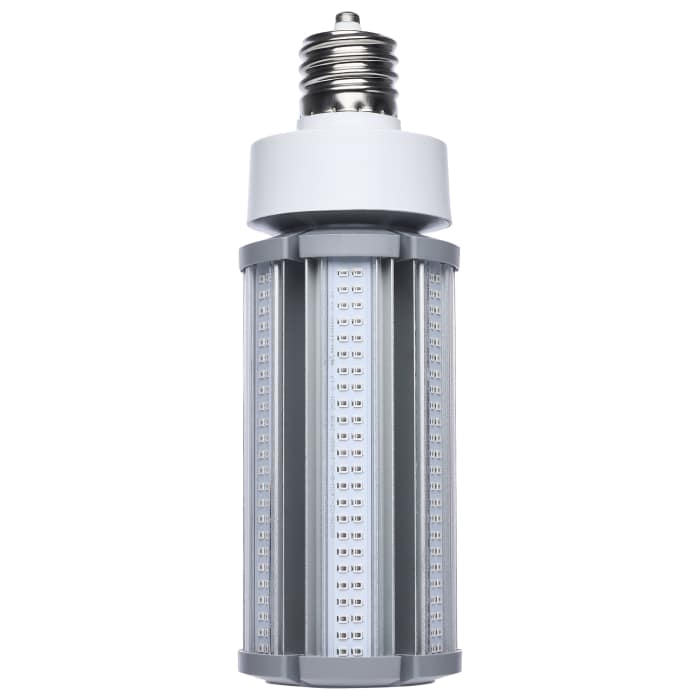
High-Intensity Discharge (HID) lighting has illuminated parking lots, warehouses, commercial buildings, and industrial facilities for decades. While newer LED technology has become the preferred choice for many applications, thousands of 50-watt HID fixtures remain in service today.
If you’re replacing a failed 50W HID lamp, it’s important to understand what type of bulb you have before purchasing a replacement. Not every HID lamp is the same, and choosing the wrong bulb can prevent your fixture from operating correctly or even damage the system.
At Unique Lighting & Home Decor, we help homeowners, business owners, electricians, and contractors identify replacement lamps and determine whether replacing the bulb or upgrading the fixture makes the most sense.
What Is an HID Light Bulb?
HID stands for High-Intensity Discharge.
Unlike incandescent or LED bulbs, HID lamps don’t produce light using a filament. Instead, they create an electric arc between two electrodes inside a sealed arc tube filled with gases and metallic compounds. As the arc heats these materials, they emit an intense, highly efficient light.
Because HID lamps produce so much light from a relatively small source, they’ve long been used for applications requiring powerful illumination.
Common examples include:
- Parking lots
- Building exteriors
- Warehouses
- Manufacturing facilities
- Sports fields
- Security lighting
- Street lighting
What Does “50W HID” Mean?
The 50W refers to the lamp’s power consumption.
Compared with larger HID lamps rated at 100, 175, 250, or 400 watts, a 50-watt HID lamp is commonly used where moderate light output is needed without the energy consumption of larger fixtures.
The actual brightness depends on the specific HID technology—not just the wattage.
Not All HID Lamps Are the Same
One of the biggest misconceptions is that “HID” refers to a single type of bulb.
In reality, HID is a family of lighting technologies.
The most common types include:
Metal Halide (MH)
Metal halide lamps are known for producing bright white light with relatively good color rendering.
They’ve traditionally been used in:
- Retail stores
- Gymnasiums
- Warehouses
- Automotive shops
- Outdoor area lighting
Advantages
- Bright white light
- Good color quality
- Suitable for commercial applications
Disadvantages
- Gradual color shift with age
- Longer warm-up time
- Requires a ballast
- Contains mercury
High-Pressure Sodium (HPS)
High-pressure sodium lamps produce the familiar golden-orange light seen in many parking lots and roadways.
Advantages
- Excellent energy efficiency
- Long service life
- Reliable outdoor performance
Disadvantages
- Poor color rendering
- Warm-up time before reaching full brightness
- Requires a ballast
Mercury Vapor
Although much less common today, some older fixtures still use mercury vapor lamps.
Compared with modern alternatives, they are less efficient and generally being phased out in favor of LED technology.
HID vs. LED
Many customers ask whether they should simply replace the HID bulb or convert the fixture to LED.
Here’s how the technologies compare:
| Feature | 50W HID | LED |
|---|---|---|
| Warm-Up Time | Several minutes | Instant |
| Energy Efficiency | Good | Excellent |
| Maintenance | Moderate | Low |
| Ballast Required | Yes | Depends on retrofit type |
| Contains Mercury | Many HID lamps | No |
| Color Stability | Changes over time | Excellent |
| Expected Lifespan | Moderate | Long |
For many commercial and residential applications, LED lighting provides lower maintenance, improved efficiency, and more consistent light quality.
Why Do HID Fixtures Need a Ballast?
Unlike LED or incandescent bulbs, HID lamps require a ballast.
The ballast performs several important functions:
- Starts the lamp
- Regulates electrical current
- Maintains stable operation
- Prevents excessive current from damaging the lamp
If a new HID bulb doesn’t operate correctly, the problem may actually be a failing ballast rather than the lamp itself.
Can You Replace an HID Bulb with LED?
In many cases, yes.
However, there are several different retrofit methods.
Direct Replacement
Some LED retrofit lamps are designed to fit existing HID fixtures.
Always verify compatibility with the fixture and ballast.
Ballast Bypass
Some LED retrofit systems require removing or bypassing the ballast.
This reduces future maintenance but should only be performed according to the manufacturer’s instructions and applicable electrical codes.
Complete Fixture Replacement
Older fixtures with worn reflectors, aging ballasts, or weather damage may benefit from replacing the entire fixture rather than only the lamp.
Common Applications for 50W HID Lamps
Depending on the fixture design, 50W HID lamps are commonly found in:
- Wall pack fixtures
- Small parking lot lights
- Building security lighting
- Walkway lighting
- Landscape accent lighting
- Commercial entryways
- Storage facilities
- Industrial work areas
If your fixture is more than 15 to 20 years old, it may be worth evaluating whether an LED upgrade would provide better performance and lower maintenance costs.
Common Mistakes Homeowners and Business Owners Make
Assuming All HID Lamps Are Interchangeable
Metal halide, high-pressure sodium, and mercury vapor lamps are not interchangeable.
Always verify the lamp type specified for your fixture.
Replacing the Lamp Without Checking the Ballast
If a new HID bulb fails to start, the ballast—not the bulb—may be the cause.
Ignoring Color Temperature
LED replacements are available in several color temperatures.
Choosing the appropriate color can improve visibility while maintaining the appearance of the property.
Waiting Until Multiple Fixtures Fail
When several HID fixtures begin failing around the same time, replacing them as a group, or upgrading to LED, may reduce future maintenance costs.
Showroom Tip
One of the most common questions we hear is:
“I know it’s a 50-watt HID bulb, but I don’t know what kind it is.”
The easiest solution is to bring the old lamp, or a clear photo of the bulb and fixture label, into our showroom. The markings on the lamp or ballast often identify the exact replacement needed.
Visit Unique Lighting & Home Decor
Whether you’re maintaining commercial lighting, replacing a security light, or considering an LED upgrade, we’re here to help.
At Unique Lighting & Home Decor, we can help identify replacement HID lamps, explain LED retrofit options, and recommend solutions based on your building, fixture, and lighting goals.
Visit us at:
Unique Lighting & Home Decor
926 S. Arizona St.
Butte, MT 59701
If you’ve never wandered through our showroom, you should.
Bring your existing lamp—or a photo of the fixture—and let our lighting experts help you find the right replacement.
References (APA 7th Edition)
National Electrical Manufacturers Association. (2020). ANSI C78 Series: Electric Lamps—Dimensional and Electrical Characteristics.
U.S. Department of Energy. (n.d.). LED Lighting. https://www.energy.gov/energysaver/led-lighting
U.S. Environmental Protection Agency. (n.d.). Frequent Questions About Mercury-Containing Lamps. https://www.epa.gov/cfl
Illuminating Engineering Society. (2022). The Lighting Handbook (11th ed.).


Leave a Reply