
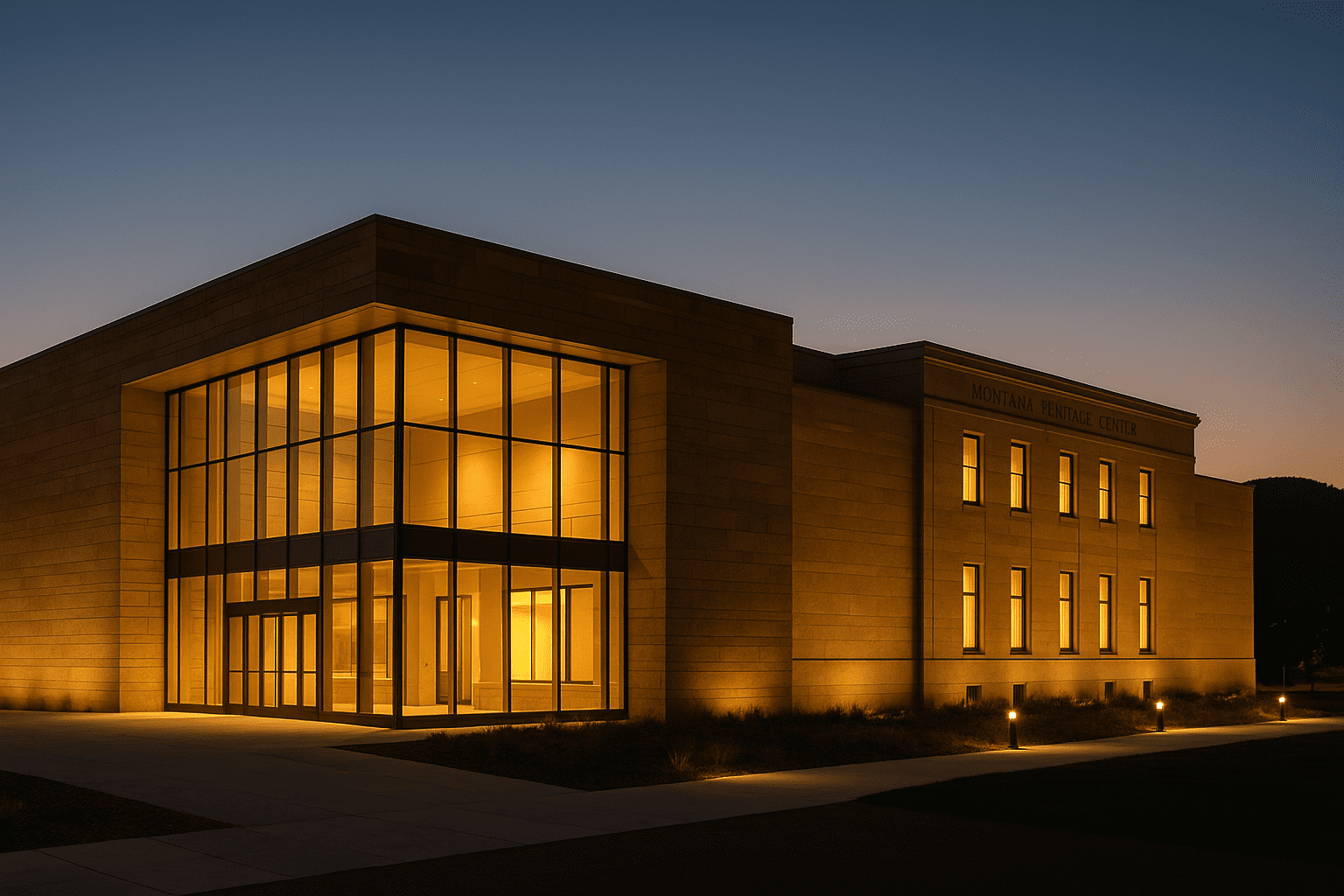
Rising from Helena’s southern edge, the Montana Heritage Center is more than a museum — it’s a conversation between land, light, and legacy. Designed to expand and complement the original 1953 Veterans and Pioneers Memorial Building, the Heritage Center redefines how architecture can honor history while embracing the future.
(Montana Department of Administration, 2024)
Opening in late 2025, the 67,000-square-foot center is crafted to draw in natural light, connecting interior exhibits to Montana’s vast horizon. Its glass and stone façade — inspired by geological strata — glows from within like the embers of an evening campfire, blending modern design with deep regional resonance.
Architecture Framed by Light
Architects from Cushing Terrell designed the Heritage Center with a clear guiding principle: “light as landscape.” Large, south-facing windows, layered shading systems, and clerestory apertures allow daylight to sculpt the building’s interior volumes throughout the day.
Inside, ambient and directional lighting transitions fluidly between exhibit areas — illuminating artifacts, interpretive installations, and architectural features without overwhelming them. The design celebrates contrast: soft daylight meets focused accent lighting, creating a dialogue between natural and human-made illumination.
(Cushing Terrell, 2023)
Daylight as Design
The Heritage Center’s approach to daylight is deliberate and ecological. Daylight sensors and automated shades regulate brightness to protect sensitive displays while minimizing energy use. At dusk, the building transforms — glass walls turn into lanterns, revealing silhouettes of visitors inside.
This concept — architecture as a vessel of light — aligns perfectly with modern principles of sustainable lighting design. By letting natural light carry much of the work, the building reduces dependence on artificial sources, echoing Montana’s ethic of conservation and balance.
Interpreting Heritage Through Illumination
In the Montana Heritage Center, light itself becomes an interpretive tool. Exhibit designers use varying intensities and color temperatures to create emotional transitions — from the warm, immersive light of early settlement stories to cooler tones representing the state’s natural landscapes and future-facing innovations.
Lighting here isn’t just for visibility; it’s a language. It directs movement, focuses attention, and evokes the experience of Montana’s seasons — a blend of science, storytelling, and sensitivity.
(Montana Historical Society, 2024)
Lessons for Lighting Design
- Natural Integration
Architecture and lighting must be conceived together. The Heritage Center proves that well-planned daylighting can elevate both aesthetic and performance outcomes. - Subtle Technology
Controls and automation, when invisible to users, create harmony rather than distraction — a lesson valuable for both public and residential projects. - Light as Storytelling
The lighting approach transforms a museum into an emotional journey — a reminder that light doesn’t just reveal objects; it shapes narrative.
A Modern Montana Beacon
As the sun sets behind the Helena hills, the Montana Heritage Center glows softly against the horizon — a landmark not of dominance, but of dialogue. It represents the state’s enduring spirit: respectful of history, rooted in landscape, and open to the light ahead.
For Unique Lighting and Home Decor, it stands as a testament to what lighting design can achieve — not just brilliance but meaning.
In Montana, the light never merely falls on a building — it becomes part of it.
References
Cushing Terrell. (2023). Montana Heritage Center Project Overview. Retrieved from https://cushingterrell.com/project/montana-heritage-center/
Montana Department of Administration. (2024). Montana Heritage Center Construction Update. Retrieved from https://mtheritagecenter.mt.gov
Montana Historical Society. (2024). Montana Heritage Center Expansion. Retrieved from https://mhs.mt.gov


Leave a Reply