
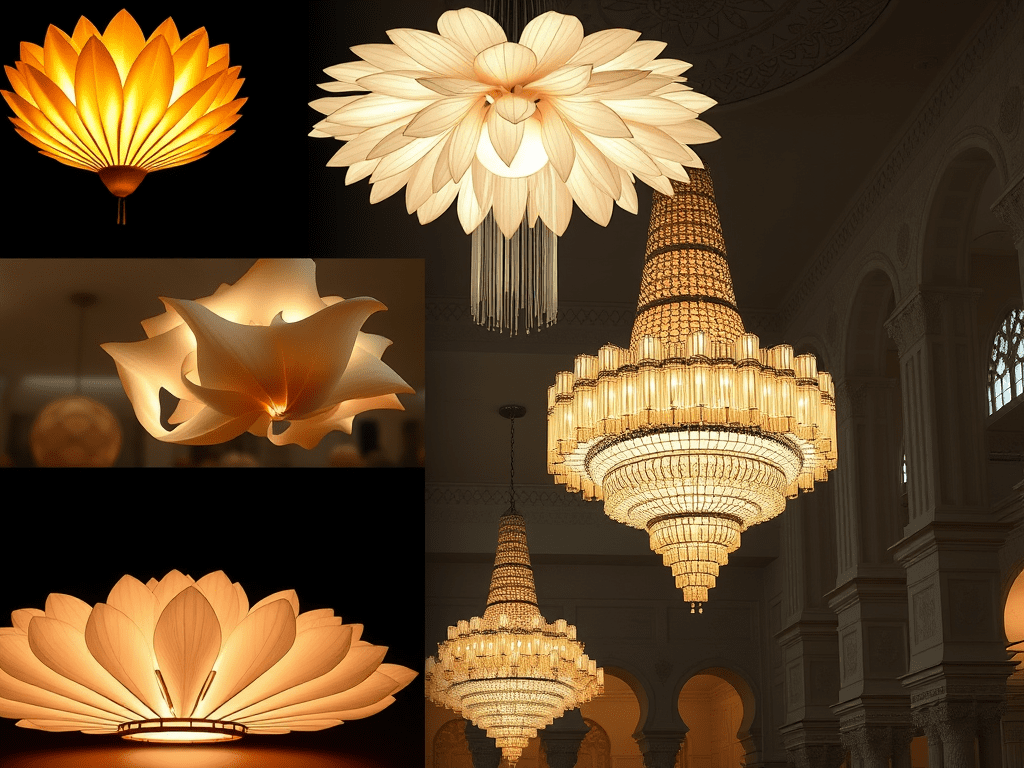
Lighting fixtures can do more than just provide illumination. They can awe, define space, and turn architecture into theater. The most dramatic lighting designs in history show how light, materials, and design combine to create works of art.
1. PH Artichoke Lamp — Poul Henningsen (1958)
The PH Artichoke Lamp, designed by Poul Henningsen and produced by Louis Poulsen, is one of the most iconic pieces in lighting history. Composed of 72 leaves arranged in 12 rows, it hides the bulb completely, producing glare-free light. Commissioned for the Langelinie Pavilion in Copenhagen, it remains a global design symbol (Architectural Digest, 2018).
2. The PH Lamp System
Henningsen’s broader PH lamp system (three-shade and four-shade models) demonstrates drama through precision. His layered designs controlled glare, softened shadows, and provided warm, functional light. These fixtures proved that lighting could be both technical and atmospheric (Wikipedia, 2023).
3. Isamu Noguchi’s “Akari” Paper Lanterns
In contrast to sculptural metal, Noguchi’s Akari series of paper lanterns are dramatic in their simplicity. Crafted from washi paper and bamboo, they glow with soft, organic light. Inspired by Japanese tradition but modern in expression, Noguchi’s lanterns remain timeless and poetic (Better Homes & Gardens, 2022).
4. Ingo Maurer’s Uchiwa Lights
In the 1970s, German designer Ingo Maurer collaborated with Japanese fan-maker Tatsuo Shigeki to create Uchiwa Lights, fixtures that transformed traditional fans into illuminated art. Their tactile textures and cultural symbolism make them deeply memorable (Architectural Digest, 2023).
5. Monumental Chandeliers
Some of the world’s most dramatic fixtures rely on scale and spectacle:
- The chandeliers of Sheikh Zayed Grand Mosque in Abu Dhabi, immense works combining Swarovski crystals and precious metals.
- Historic Murano glass chandeliers in Venetian palaces, refracting light through thousands of handmade prisms.
Both demonstrate how chandeliers can define entire interiors through light, shadow, and grandeur (Art Crystal, 2021; Wikipedia, 2023).
What Makes Lighting Dramatic?
Across these examples, the traits of dramatic lighting fixtures emerge clearly:
- Bold silhouettes that command attention.
- Mastery of glare and diffusion to sculpt atmosphere.
- Innovative materials that shift perception.
- Cultural resonance, embedding heritage into form.
- Scale and placement, transforming architecture into stagecraft.
Conclusion
From Henningsen’s meticulously engineered lamps to Noguchi’s glowing lanterns and monumental chandeliers, dramatic lighting shows us that fixtures are not just functional objects — they’re works of art. They illuminate not only spaces but also the imagination.
References
- Architectural Digest. (2018, March 29). Louis Poulsen celebrates 60 years of Poul Henningsen’s artichoke lamp. Architectural Digest. https://www.architecturaldigest.com/story/louis-poulsen-poul-henningsen-artichoke-lamp-60-years
- Architectural Digest. (2023, May 18). Rediscover Ingo Maurer’s iconic Uchiwa light. Architectural Digest. https://www.architecturaldigest.com/story/rediscover-ingo-maurers-iconic-uchiwa-light
- Art Crystal. (2021, October 15). Iconic chandeliers through the ages: The evolution of design (Part 2). Art Crystal Chandeliers. https://www.artcrystal.eu/n/iconic-chandeliers-through-the-ages-the-evolution-of-design-part-2
- Better Homes & Gardens. (2022, December 19). Paper lantern pendants are back in style. Better Homes & Gardens. https://www.bhg.com/home-improvement/lighting/planning/paper-lantern-pendants-trend
- Wikipedia. (2023). Poul Henningsen. In Wikipedia. https://en.wikipedia.org/wiki/Poul_Henningsen
- Wikipedia. (2023). Chandelier. In Wikipedia. https://en.wikipedia.org/wiki/Chandelier


Leave a Reply