
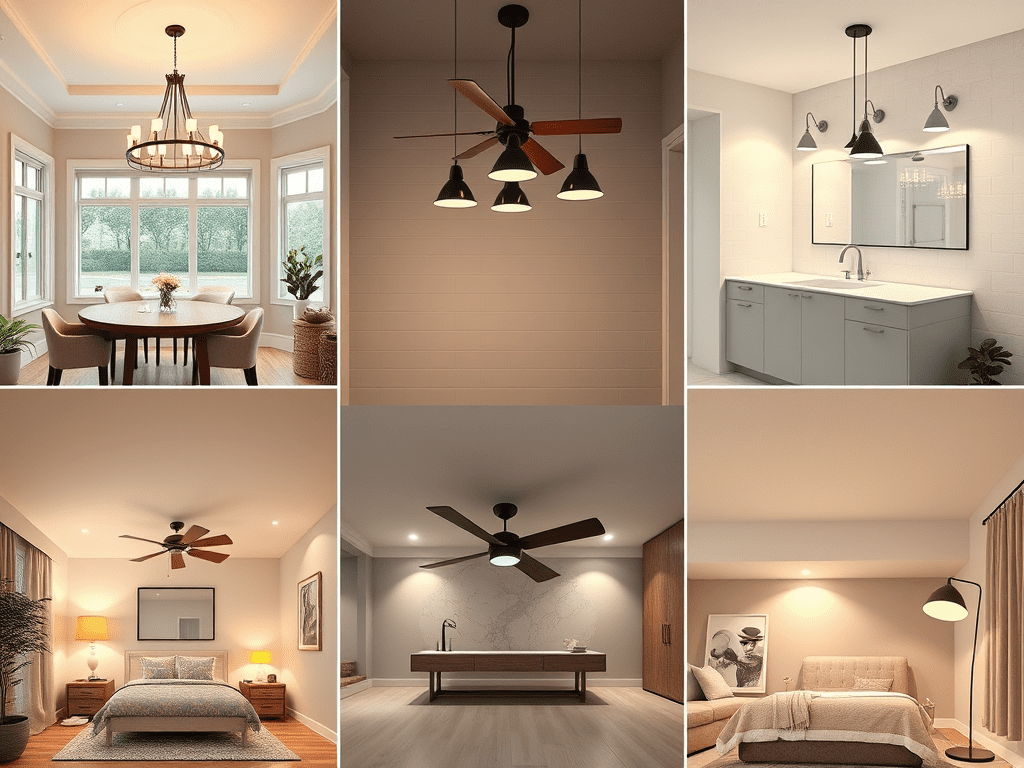
At Unique Lighting & Home Décor, we know lighting choices can feel overwhelming. From lumens and color temperature to fixture size and placement, there’s a lot to consider. To help, we’ve compiled the top 10 most-asked questions about light fixtures online, with clear, technical answers — plus insights from the American Lighting Association (ALA).
1. How many lumens do I need for a room?
Lighting levels are calculated using foot-candles (fc):
Lumens = Room square footage × target fc.
- Bedrooms: 10–20 fc
- Living Rooms: 10–20 fc
- Kitchens (general): 20–50 fc
- Kitchen prep areas: 50–100 fc
- Bathrooms: 20–50 fc
👉 Example: a 12′×14′ bedroom (168 sq. ft.) × 20 fc = 3,360 lumens total (Illuminating Engineering Society, 2018).
2. What color temperature is best for bedrooms and living spaces?
The ALA recommends below 3,000K for cozy, relaxing light. Warm white bulbs in the 2,700K–2,200K range mimic incandescent glow and support better sleep.
“For softer, warmer incandescent-type light, go lower than 3,000K to 2,700K or even 2,200K.” (American Lighting Association, 2022)
3. What’s the difference between lumens and watts?
- Lumens = brightness
- Watts = energy used
The ALA stresses buying bulbs by lumens, not watts. For example, a 10W LED can produce the same lumens as a 60W incandescent (American Lighting Association, 2022).
4. Can I use LED bulbs with my existing dimmer?
Not all LEDs work with every dimmer. Use:
- ELV dimmers for many electronic drivers
- MLV dimmers for magnetic transformers
- Trailing-edge dimmers for smoother LED performance
Always check manufacturer compatibility charts to avoid flicker or limited dimming (Lutron Electronics, 2021).
5. Are LED bulbs safe in enclosed fixtures?
Only if they’re enclosed-fixture rated. Heat build-up shortens LED life. Look for packaging that specifically states “safe for enclosed fixtures” (U.S. Department of Energy, 2020).
6. What is CRI, and how high should it be?
CRI (Color Rendering Index) measures color accuracy on a scale of 0–100.
- Good: 80+
- Best for homes: 90+ (truer skin tones, fabrics, and finishes)
High CRI is recommended for spaces where accurate color is important (Illuminating Engineering Society, 2018).
7. How high should I hang pendants over a kitchen island?
- 30–36 inches from countertop to pendant bottom (for 8′ ceilings)
- Add ~3 inches for every extra foot of ceiling height
This ensures task light without blocking sightlines (American Lighting Association, 2021).
8. What size chandelier do I need for my dining room?
- Diameter = ½ to ⅔ the table width
- Linear fixtures = ⅓ to ⅔ table length
- Hang height = 30–36 inches above the table (raise for taller ceilings) (American Lighting Association, 2021).
9. What’s the best way to light a bathroom vanity?
- Side sconces at eye level (60–66″ from floor) for even face lighting
- If space is limited: a bar light above the mirror, centered and diffused
This prevents harsh shadows (National Kitchen & Bath Association, 2019).
10. How do I know if I have “enough” light beyond lumens?
It’s not just lumens — it’s layering and reflectance.
- Walls ~50% reflective
- Ceilings ~80% reflective
- Floors ~20% reflective
Combine ambient + task + accent lighting for a balanced feel (Illuminating Engineering Society, 2018).
Bonus: Should I use a ceiling fan with a light in the bedroom?
Yes. Ceiling fans with integrated LED kits give you air circulation + ambient lighting in one fixture.
- Quiet, efficient motors (for sleep)
- Dimmable, warm LED lights (2,700K)
- Reversible fans to push warm air down in winter
The ALA notes that ceiling fans are becoming focal points in bedrooms, offering both comfort and design impact (American Lighting Association, 2021).
Final Word from the ALA
The American Lighting Association emphasizes that lighting is more than utility:
“Lighting should enhance your life at home — balancing function, safety, and ambiance.” (American Lighting Association, 2016)
References
American Lighting Association. (2016). Lighting consumer study. ALA. Retrieved from https://alamembers.com/Portals/1/ALA_LightingConsumerStudy_16_FINAL.pdf
American Lighting Association. (2021). Fixture placement and sizing guidelines. ALA Lighting. Retrieved from https://alalighting.com
American Lighting Association. (2022). Be brighter with bulb basics. ALA Lighting. Retrieved from https://alalighting.com/Design-Inspiration/Email-Newsletter/ArtMID/1779/ArticleID/723/Be-brighter-with-bulb-basics-from-ALA
Illuminating Engineering Society. (2018). Lighting handbook (10th ed.). New York: IES.
Lutron Electronics. (2021). LED compatibility tool. Lutron. Retrieved from https://www.lutron.com
National Kitchen & Bath Association. (2019). Kitchen and bath lighting guidelines. NKBA.
U.S. Department of Energy. (2020). LED basics. DOE Energy Efficiency & Renewable Energy. Retrieved from https://www.energy.gov/eere/ssl/led-basics


Leave a Reply